
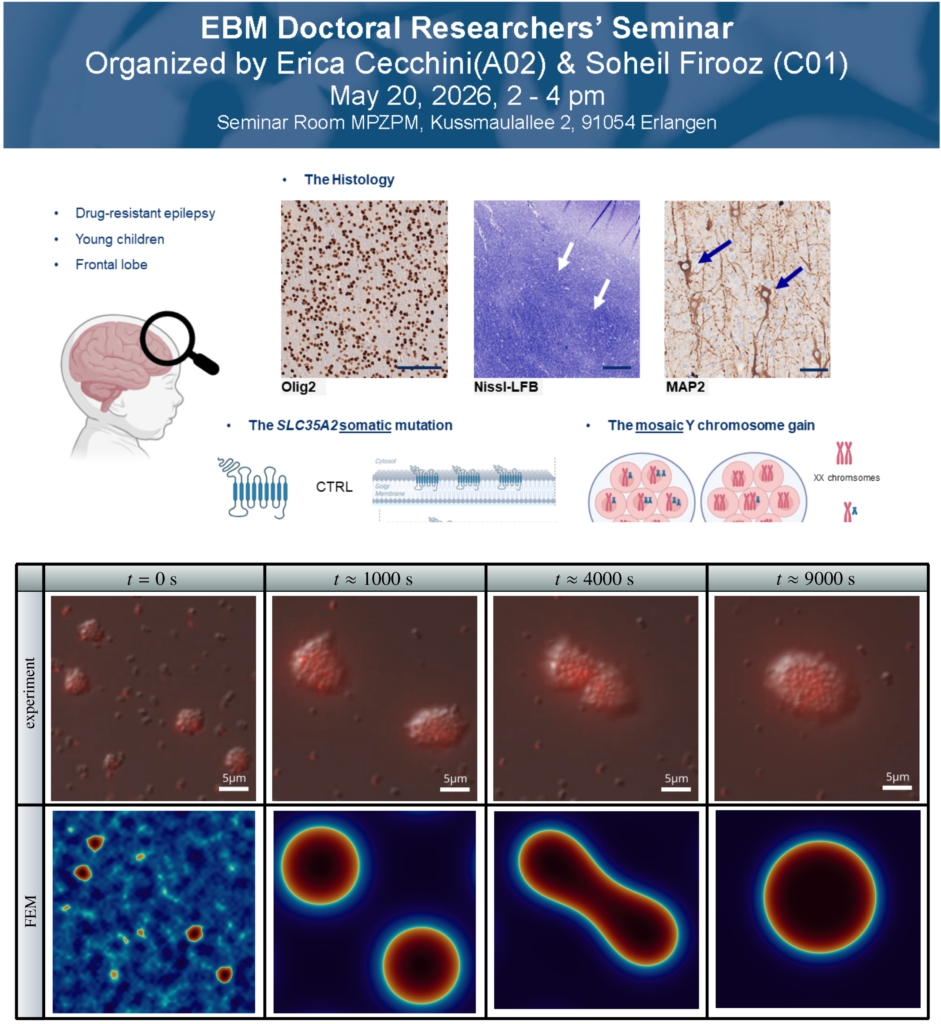
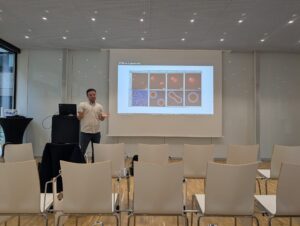
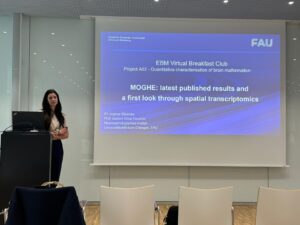
On May 20, 2026, Erica Cecchini and Soheil Firooz jointly held a doctoral seminar at the MPZPM in Erlangen, providing an opportunity to present and discuss their ongoing doctoral research projects.
Erica Cecchini presented her recently published work on MOGHE, a cortical malformation associated with drug-resistant epilepsy that is frequently linked to somatic SLC35A2 mutations. Analyzing a cohort of 29 patients, her group identified an unexpected genomic feature: an excess of Y-chromosomal material within the malformed brain tissue. This alteration was detected in 84% of male patients (16/19) and, remarkably, also in 50% of female patients (5/10). Importantly, the Y-chromosomal material was restricted to the lesion and was not detected in adjacent non-lesional brain tissue.
Based on these findings, the authors distinguished three molecular subgroups: patients carrying only SLC35A2 mutations, patients with both SLC35A2 mutations and Y-chromosome gain, and patients exhibiting Y-chromosome gain without SLC35A2 mutations. The combined mutation and Y-gain group tended to show earlier seizure onset, larger lesions, and more severe cognitive impairment. However, these differences did not reach statistical significance due to the limited cohort size.
Although the study does not establish a causal role of Y-chromosomal material in MOGHE or epilepsy, it reveals a previously unrecognized genomic characteristic of the disorder. The recurrent presence of Y-chromosomal sequences, even in female patients, suggests that sex-chromosome abnormalities may contribute to the pathobiology of MOGHE.
Soheil Firooz presented the Double-Agent Framework, a theoretical approach developed to model neural network formation in the brain. In this framework, one agent represents neurons, while the second agent represents either glial cells or components of the extracellular matrix. Starting from an agent-based description and applying coarse-graining techniques, the work resulted in a continuum model capable of capturing both intra-species and inter-species interactions within a double-agent system.
Overall, the seminar showcased two innovative doctoral research projects and provided a valuable platform for scientific discussion and feedback.
Soheil Firooz, C01